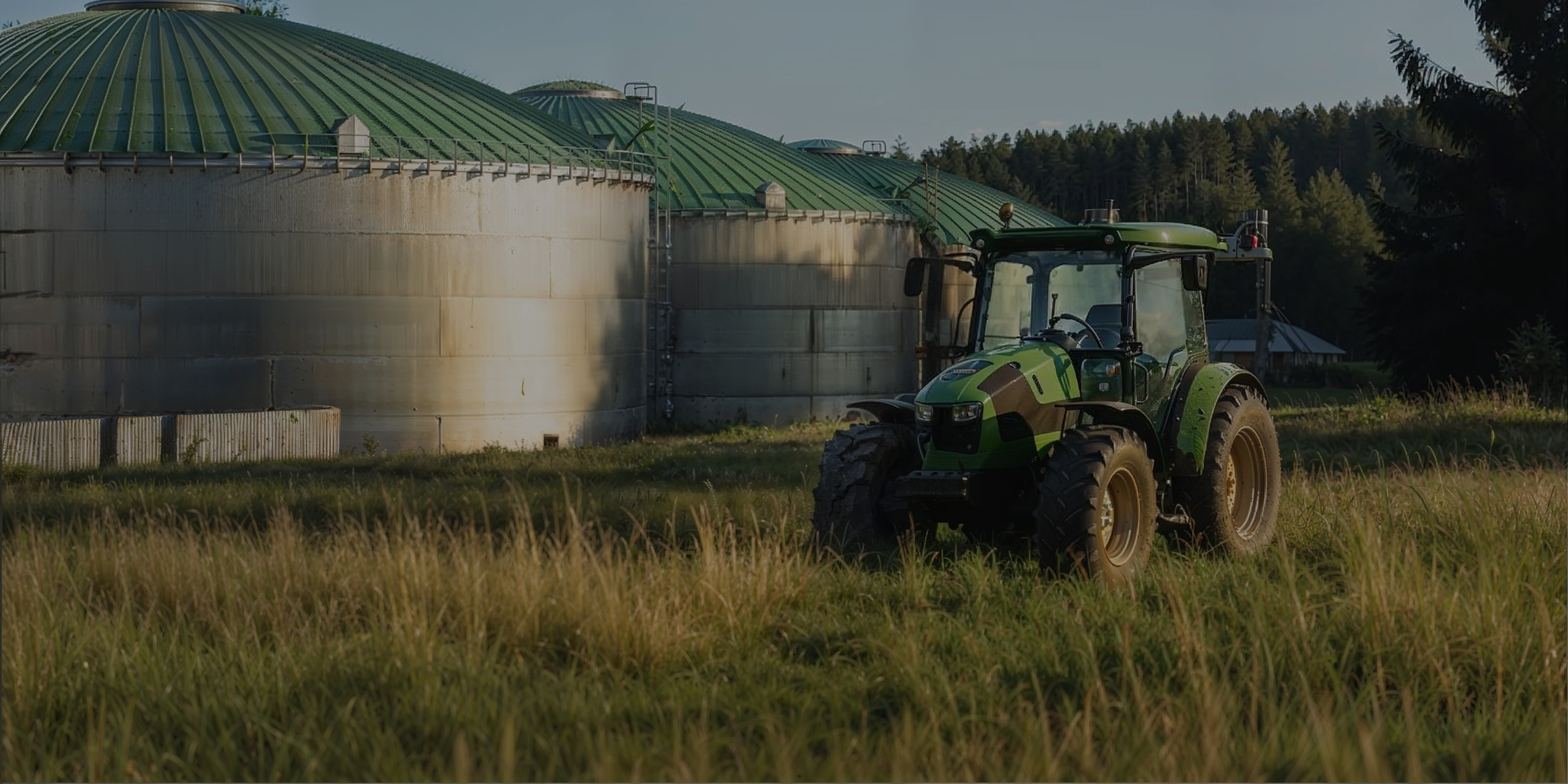
How to prepare raw materials for a biogas plant: secrets of efficiency

Ruslan Delidon — 15.09.2025


Ruslan Delidon — 15.09.2025
Successful production of biogas from agricultural raw materials begins long before the equipment is launched. One of the main factors determining how stable the fermenter will be, how much energy you will get, and how quickly the project will pay off is the preparation of raw materials for the biogas plant.
The ProEnergy team shares five practical secrets that we apply in our bioenergy projects. This knowledge is based not only on theory, but also on experience in launching real facilities in Ukraine.

The first and most important step is to select the right raw materials for the biogas plant. These can include corn silage, beet pulp, manure, slurry, chicken or turkey manure, agricultural waste, or food waste, depending on the specifics of the enterprise.
Raw materials are the basis of the process on which the biogas plant is built, but it is not enough, for example, to simply have a large amount of manure and expect a large yield of biogas. It is necessary to pay attention to the dry matter content and the carbon to nitrogen ratio — C/N balance. When considering manure with a low dry matter (DM) content, it is worth considering additional co-substrates that increase the organic content, such as solid cattle manure, straw, silage, etc. In this case, the biogas yield from 1 volume of the fermenter will be significantly higher than when fermenting manure alone, and the efficiency of the plant will be higher. We could also add relatively dry chicken manure (35-60%, compared to 5-9% in slurry) to the slurry, and this raises the question of the C/N balance. The ideal ratio is between 20:1 and 30:1. The example of manure and slurry clearly shows that exceeding these limits can lead to an excess of nitrogen and its toxicity, since both manure and slurry have a high nitrogen content.
Conducting a laboratory analysis of the substrate composition is a mandatory initial procedure, without which it is impossible to calculate the required volume of the biogas reactor, determine the expected yield of the final product, and select the required proportion of co-substrates and, accordingly, the technology for loading them into fermenters.
Once you have selected the raw materials and determined the correct ratio of components, the next important step is to ensure that they are technically prepared for fermentation.
Even the most ideal C/N ratio will not work if the bacteria cannot physically reach the nutrients. This is why pre-treatment of the biogas substrate (pre-treatment stage) is necessary.
Its main task is to mechanically grind and convert large particles of raw materials into smaller, more accessible fractions, which significantly improves contact with microorganisms. Our technology does not require additional resources or space for this, as it takes place at the loading stage: special cutters are installed directly before the raw materials are fed into the hopper, which grind the material to the required size for efficient fermentation. However, this is not enough for fibrous raw materials, such as straw. To increase the efficiency of a biogas plant, additional processing is required — mechanical or enzymatic. Its purpose is to break down cellulose and hemicellulose fibers. Without this, the fermentation process will be slower and less efficient. As a result, after such additional pre-treatment, biogas output can increase by 20–30%.
Another important aspect is thermal disinfection. It destroys pathogens in animal waste, but is not applicable to all types of raw materials. If the production process involves the use of slaughter products, carcasses, or meat processing waste, sanitation becomes a mandatory requirement. This is clearly defined by law and applies only to materials that potentially contain infectious agents. Such treatment is not necessary for ordinary manure, so additional equipment is not required in this case.
Therefore, the efficiency of a biogas plant largely depends on the proper preparation of raw materials. However, even with proper pre-treatment, it is necessary to constantly monitor the fermentation environment — temperature, pH level, humidity, etc.
Biogas does not form in a random environment. It is produced by special bacteria — methanogens — that work only under specific conditions. The most sensitive parameter is the acidity level. If the pH exceeds 6.5–7.5, the activity of the bacteria decreases, and with it, gas production.
But lowering the pH is only one factor. An excess of ammonia, hydrogen sulfide, heavy metals, or volatile fatty acids can completely halt the fermentation process.
Bacteria are capable of independently controlling the level of LJC and pH, if the supply of substrate is stopped at the right moment thanks to the buffer capacity of the medium, which occurs in a timely manner provided that FOS/TAK is monitored and pH is controlled.
To neutralize hydrogen sulfide, air, oxygen, or iron ion compounds are added, which prevents equipment corrosion and ensures uninterrupted operation of the biogas plant. Even under properly controlled conditions, efficiency can remain low without a critically important but often underestimated resource — trace elements.
Trace elements are invisible ingredients without which bacteria simply cannot maintain fermentation. They are like vitamins for humans: we can live without them, but we cannot reach our full potential.
The most important ones are nickel, cobalt, iron, molybdenum, tungsten, selenium, manganese, and nickel. Their deficiency leads to a slowdown in the process, acid accumulation, and a decrease in methane potential. Therefore, we recommend conducting a complete analysis of the raw material composition in order to calculate which trace elements will be needed for the biogas plant.
Even the best supplements cannot replace the right combination of raw materials, which ensures a natural balance of substances. And this is where the next strategy comes into play — co-digestion.

As mentioned above, a single raw material does not always provide all the necessary properties: nutritional value, moisture content, carbon profile, and micronutrient content. That is why more and more biogas plants operate on the principle of co-digestion — the simultaneous fermentation of several types of raw materials (co-substrates).
A classic example is manure + corn silage or bird droppings + food waste. Such mixtures allow you to balance the pH, improve the consistency of the mass, stabilize fermentation, and increase biogas yield.
Raw material preparation is the key to stable operation and high efficiency of a bioenergy project. From the competent selection of raw materials and C/N balance to the mechanical pre-treatment of the substrate for biogas, buffering of the environment, control of trace elements and synergy of co-substrates — each step directly affects the amount of biogas produced, the fermentation rate and the overall economics of the project.
✅ By optimising your approach to raw material preparation, you will:
The ProEnergy team will help you calculate the area for a biogas plant, select the best raw materials, anticipate possible risks, and ensure maximum efficiency of your bioenergy project from day one.
Laboratory analysis or calculation based on tabulated data, which must be adjusted in case of changes in the composition of raw materials.
For fibrous raw materials — physical (mechanical + thermal) or enzymatic treatment; for pulp — mechanical (usually does not require additional special treatment).
Regular measurements of pH, FOS/TAC, VFA, NH₃, H₂S.
Only when using single raw materials, such as silage or mixtures with low mineral content.
Send us a request, and we’ll personally provide the answers during a consultation.
Thank you for your request! The manager will contact you shortly to answer all your questions.
In the meantime, check out our implemented projects.
Periodically, you will receive letters from us with all the latest news from the field of bioenergy.
So that the letters do not end up in spam, please add info@pro-energy.com.ua to the list of contacts in the mail.
We will be in touch!