Many years of experience
We have been successfully operating in the bioenergy sector since 2014. We have the knowledge, experience and understanding of the specifics of working in the Ukrainian market.


Production of biogas from the organic fraction of municipal solid waste after sorting. We transform waste into a source of energy, cost savings and stable operations for the business.
You run a municipal solid waste sorting facility and are looking for a way to dispose of organic waste
You need an alternative to incineration or landfill
You are looking to reduce your waste disposal costs
You want to turn sorting into a fully-fledged source of income
Waste sorting plants produce the organic fraction of municipal solid waste (OFMSW), which can serve as a feedstock for biogas production, namely food waste (food scraps, spoiled food, vegetable and fruit peelings), green (garden) waste (grass, leaves), food-contaminated paper products unsuitable for recycling, etc.
Due to their heterogeneous composition and high dry matter content, dry anaerobic digestion (dry AD, garage-type, plug-flow) plants or hybrid systems are best suited for such facilities. Such technologies are better adapted to the presence of impurities in the organic fraction, are more resilient to unstable feedstocks, and are less sensitive to their composition than conventional CSTR solutions..
At the same time, just like conventional CSTR systems, they require the feedstock to be prepared before being fed into the biogas plant: sorting, shredding, separation, and homogenisation. This ensures stable biogas production, reduces the risk of foreign matter entering the system. and protects the equipment from damage.

Book a free consultation, and our managers will provide comprehensive information regarding your questions.


For waste sorting facilities, we use conventional biogas plants, provided that co-fermentation with other, more stable substrates is carried out. This ensures more consistent operation of the digesters throughout the year, as the composition of the organic fraction of municipal solid waste varies depending on the season. If co-fermentation is not feasible, we recommend dry fermentation technology or hybrid solutions for processing the organic fraction of MSW.
To ensure the stable operation of a biogas plant, it is advisable to co-ferment the organic fraction of municipal solid waste with more stable substrates, such as manure, silage, or food waste. This helps to balance the composition of the feedstock, minimise seasonal fluctuations, stabilise the fermentation process, and ensure a predictable biogas yield throughout the year.
We provide a range of engineering and consulting services for project implementation. From concept to efficient operation of the plant using your raw materials and location.


We are committed to long-term partnerships

Many years of experience
We have been successfully operating in the bioenergy sector since 2014. We have the knowledge, experience and understanding of the specifics of working in the Ukrainian market.

Unique partnerships
We have reliable partners. Therefore, we can offer solutions that will allow each project to reach its full potential.

Reliable technologies
We use technologies with 90% availability for stable operation of installations, which guarantees efficiency and return on investment.

Stable work
We do not leave our customers alone after commissioning the facility. We provide 24/7 technical support and remain available under any circumstances.
Leave a request for a free consultation.
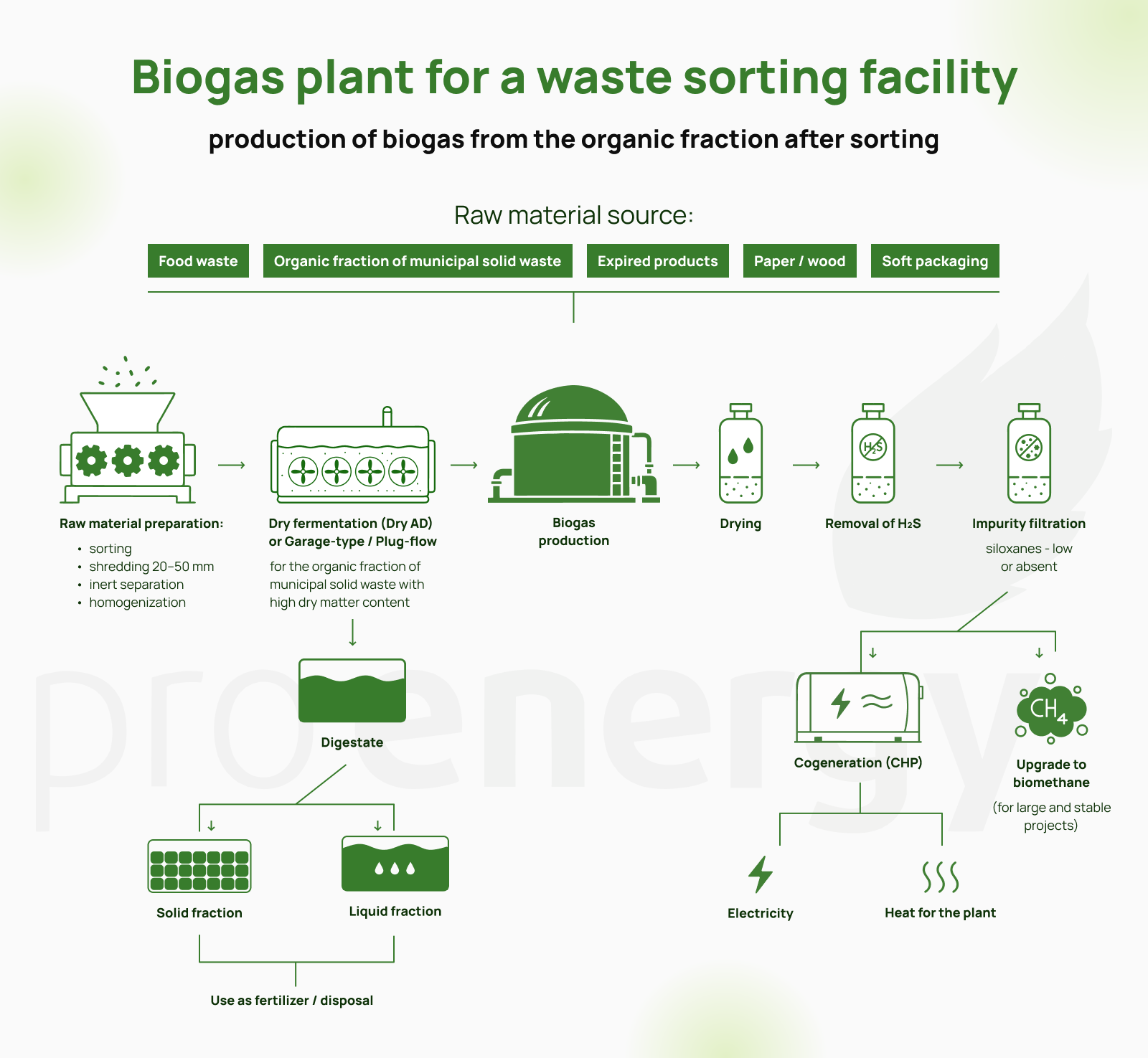
The organic fraction of municipal solid waste (OFMSW), which remains after sorting, is used for biogas production. This includes food scraps, paper, wood, soft packaging, expired products, and other organic components. It is precisely this raw material that is most commonly used in biogas plants in Ukraine for energy generation.
For MSW, the most effective biogas plants are dry fermentation systems (dry AD, garage-type, plug-flow) and hybrid systems. They operate with a high dry matter content and are resistant to foreign contaminants. Conventional CSTR solutions are only feasible after thorough preparation and homogenisation of the feedstock.
Before being fed into the biogas production plant, the organic fraction undergoes mechanical and manual sorting, shredding to 20–50 mm, separation of metal, glass, and sand, as well as homogenisation. Sanitisation is applied where necessary. This ensures stable biogas production and protects the equipment from damage.
Dry fermentation allows for the efficient processing of the organic fraction of MSW with a high dry matter content without complex substrate preparation. Such biogas plants have lower energy consumption, are simpler to operate, and are better adapted to the variable composition of waste.
On average, 90–140 m³ of biogas can be produced from 1 tonne of organic fraction. The exact figure depends on moisture content, organic matter content, and the quality of sorting. To ensure stable biogas production, it is important to minimise the amount of inert impurities in the feedstock.
Biogas from municipal solid waste undergoes mandatory drying and purification to remove H₂S (typically 500–2000 ppm). This is achieved using refrigeration dryers, biological desulphurisation, activated carbon, and microaeration systems. Unlike landfill gas, siloxane levels here are usually low.
Most commonly, biogas is used to generate electricity and heat via combined heat and power (CHP) units. For waste sorting facilities, this offers the opportunity to cover some or all of their own energy consumption. In larger projects, it is also possible to upgrade biogas to biomethane.
Biogas plants for municipal solid waste can operate reliably for over 20 years, provided they receive regular maintenance and a steady supply of organic feedstock. The service life of the main equipment depends on the quality of feedstock preparation and the biogas purification systems.
Thank you for your request! The manager will contact you shortly to answer all your questions.
In the meantime, check out our implemented projects.
Periodically, you will receive letters from us with all the latest news from the field of bioenergy.
So that the letters do not end up in spam, please add info@pro-energy.com.ua to the list of contacts in the mail.
We will be in touch!