Many years of experience
We have been successfully operating in the bioenergy sector since 2014. We have the knowledge, experience and understanding of the specifics of working in the Ukrainian market.


We produce biogas from the organic fraction of household solid waste and landfill sites. Turn waste into a stable source of income.
You manage a solid waste landfill and are planning to introduce the use of biogas
You are planning to set up, or already have, a sorting facility that accumulates organic municipal solid waste
Methane emissions and environmental risks need to be reduced
You are planning to generate electricity from biogas
Municipal solid waste (MSW) is a mixed stream of waste containing an organic fraction that can serve as a source of biogas. Biogas can be obtained from MSW in two ways: through landfill degassing or by separating the organic fraction for subsequent biogas production at dedicated biogas plants.
In landfills, biogas forms naturally within the landfill body, after which it is collected, purified, and used to generate electricity. An alternative approach involves pre-sorting waste and processing organic matter in biogas plants (e.g., CSTR), which also allows for the production of biomethane and increases the efficiency of biogas utilisation.
Our partner, HoSt, has experience in implementing projects such as the biogas plants in Lisheen (Ireland, 2024), Wiltshire (United Kingdom, 2021), Merselo (Netherlands, 2018), as well as a project in Waalwijk (Netherlands, 2015), where organic waste and expired products are converted into biomethane and food-grade CO₂.

Book a free consultation, and our managers will provide comprehensive information regarding your questions.


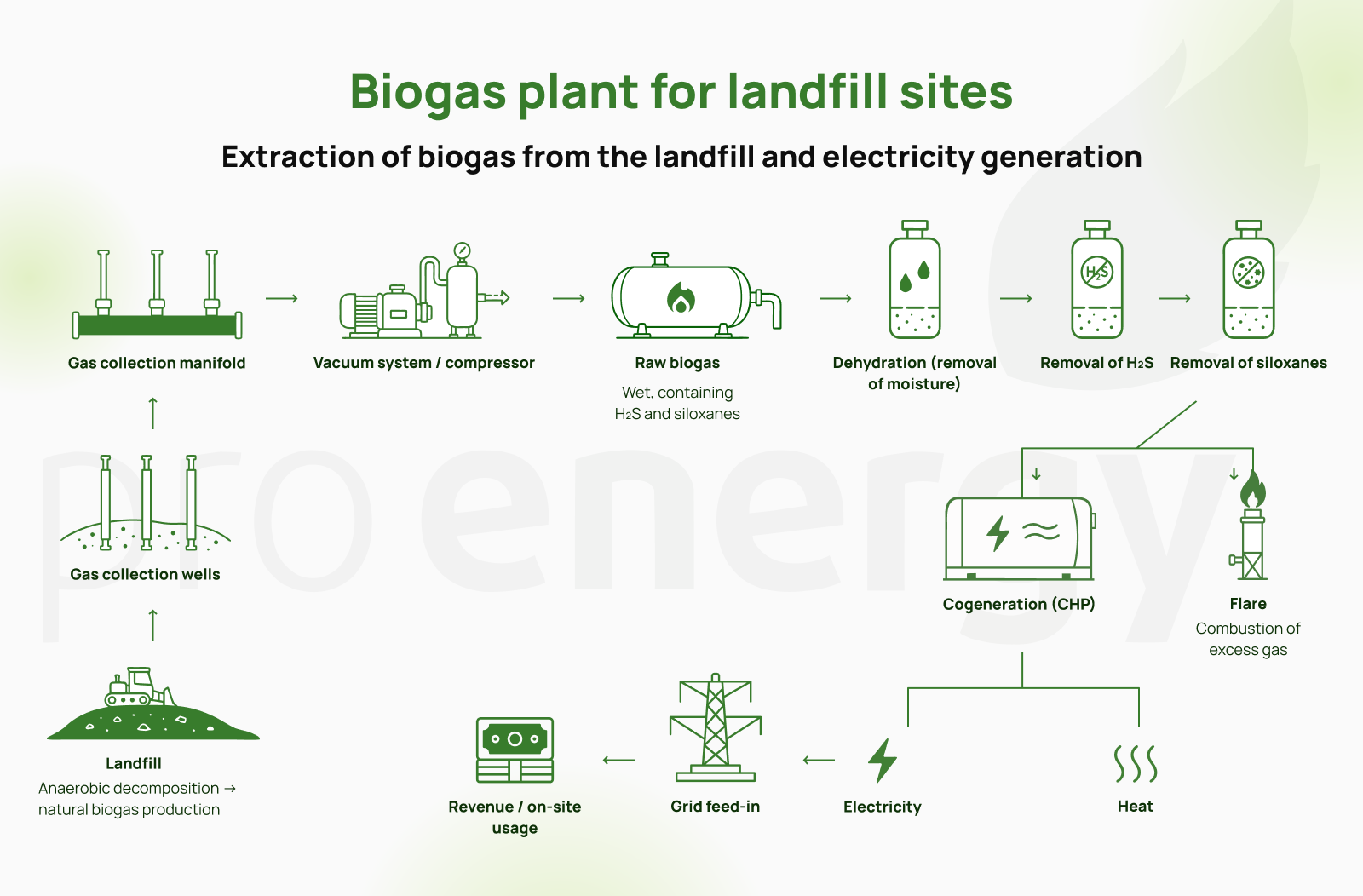
Biogas production is possible in biogas plants that process the organic fraction of municipal solid waste in combination with co-substrates, ensuring a stable gas yield throughout the year. At the same time, biogas is produced naturally at municipal solid waste landfills and requires degassing systems: wells, collectors, and purification.
The biogas is dried, purified of H₂S and impurities, and used to generate electricity in combined heat and power (CHP) plants or as an energy source within the enterprise.
We provide a range of engineering and consulting services for project implementation. From concept to efficient operation of the plant using your raw materials and location.


We are committed to long-term partnerships!

Many years of experience
We have been successfully operating in the bioenergy sector since 2014. We have the knowledge, experience and understanding of the specifics of working in the Ukrainian market.

Unique partnerships
We have reliable partners. Therefore, we can offer solutions that will allow each project to reach its full potential.

Reliable technologies
We use technologies with 90% availability for stable operation of installations, which guarantees efficiency and return on investment.

Stable work
We do not leave our customers alone after commissioning the facility. We provide 24/7 technical support and remain available under any circumstances.
Leave a request for a free consultation.
No. Biogas is produced directly within the landfill itself. In this case, a biogas plant refers to a system for collecting, treating, and utilising the biogas.
Biogas is formed as a result of the anaerobic decomposition of the organic fraction of waste. The process occurs naturally, without reactors, thanks to the temperature and humidity inside the landfill.
A degassing system is employed: drilling of gas wells, a network of collectors, and vacuum gas extraction. This forms the basis for biogas plants at landfill sites.
Typically: 40–55% methane, high moisture content, and the presence of hydrogen sulphide and siloxanes. This is precisely why biogas purification is an essential step.
Biogas undergoes drying and purification to remove H₂S (100–1000 ppm) and siloxanes. Refrigeration dryers and adsorption filters are used for this purpose.
The most efficient use is for electricity generation via combined heat and power (CHP). Biomethane derived from landfill gas is rarely used due to its unstable composition.
From an unorganised landfill — 3–5 years; from an organised one — up to 8–12 years, depending on the composition of the waste.
These projects are cheaper than conventional biogas plants as they do not require reactors. The payback is achieved through electricity generation and reduced environmental costs.
Thank you for your request! The manager will contact you shortly to answer all your questions.
In the meantime, check out our implemented projects.
Periodically, you will receive letters from us with all the latest news from the field of bioenergy.
So that the letters do not end up in spam, please add info@pro-energy.com.ua to the list of contacts in the mail.
We will be in touch!