How to sell surplus electricity from a combined heat and power plant

Oleh Yovzhenko — 08.07.2026

Oleh Yovzhenko — 08.07.2026
A cogeneration plant can not only reduce electricity and heating costs, but also generate additional income. Following changes to the electricity market, Ukrainian businesses have been given the opportunity to officially sell surplus electricity they generate themselves through the self-generation scheme. For a business with a 500 kW cogeneration unit, this could mean hundreds of thousands of hryvnias in additional monthly revenue.
The key requirement is to obtain “active consumer” status. It is this status that enables businesses to legally feed surplus electricity into the grid without needing a generation licence. In this article, we will look at how the sale of surplus electricity works, what mechanisms are available to businesses, and how much can realistically be earned.
According to the Distribution Systems Code (Chapter 4.12.2), an active consumer is an electricity consumer who owns a generating facility and can feed surplus electricity into the grid. It is this status that enables businesses to utilise the self-generation mechanism and sell surplus electricity without obtaining a generation licence.
For owners of combined heat and power plants, this is the simplest way to monetise their electricity generation. Unlike electricity producers, active consumers do not require a licence to generate electricity.
To make use of the self-production mechanism, several requirements must be met:
For example, if a company’s contracted capacity is 600 kW, the maximum amount of electricity it can feed into the grid will be 300 kW.
The self-generation mechanism is the main tool for selling surplus electricity for businesses with combined heat and power plants.
The idea is simple:
At the same time, a manufacturer’s licence is not required.
Read more about the development of the cogeneration market in Ukraine in our article.
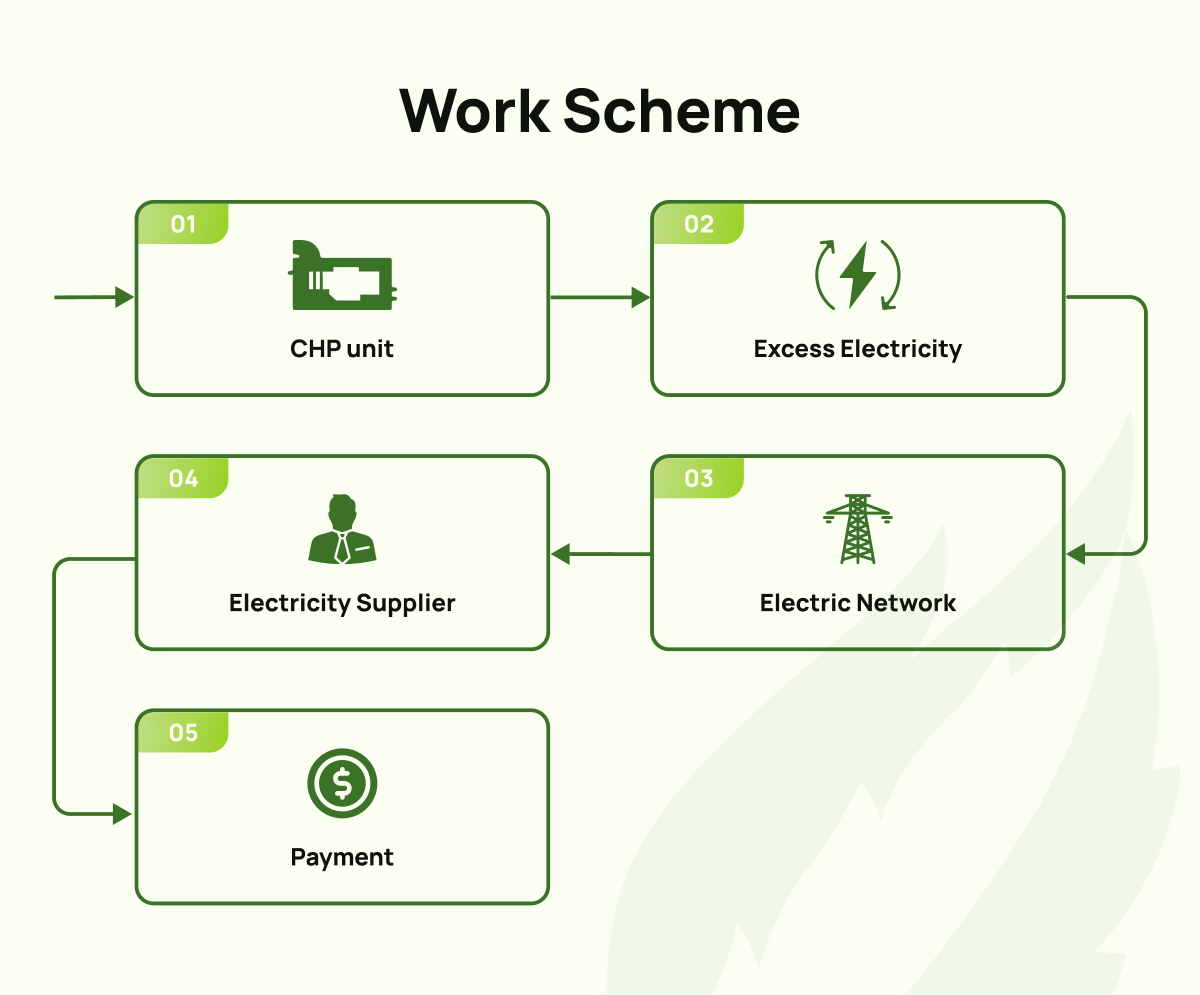
The algorithm is as follows:
The basis for the calculation is the “day-ahead” (DA) market price. The formation of DA prices and the procedure for making payments are governed by the Electricity Market Rules, which set out the mechanisms for trading electricity and for interaction between market participants.
A distinctive feature of the RDN is that prices change every hour.
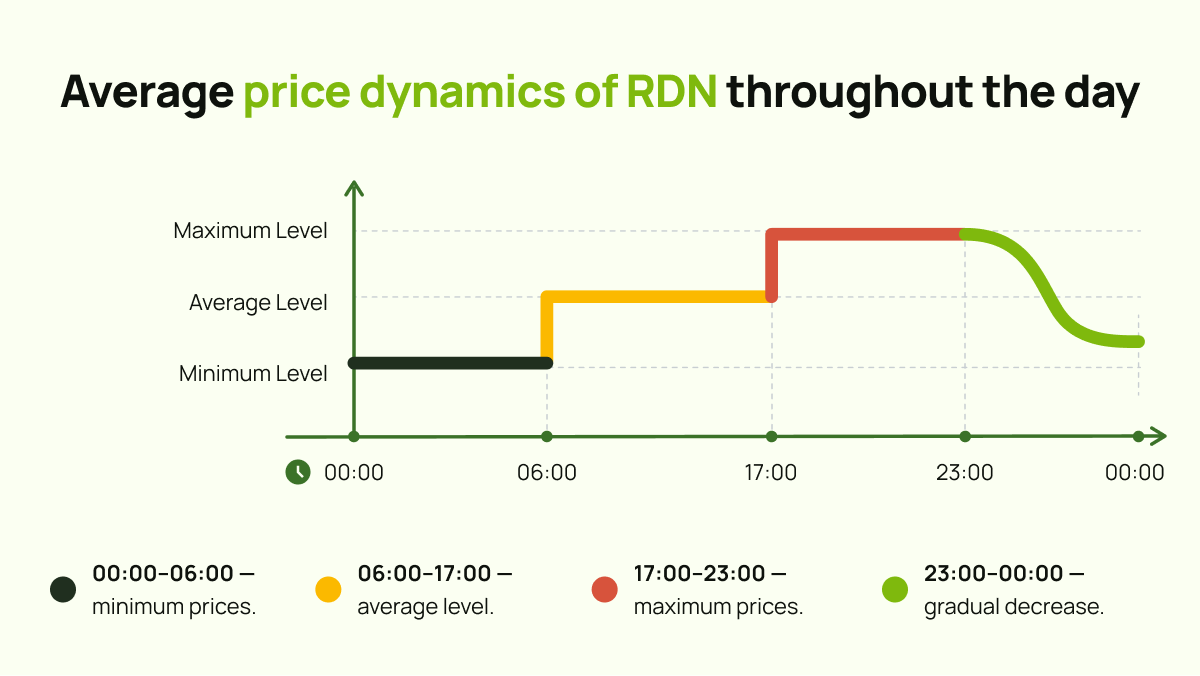
The terms for the buy-back of surplus electricity are set out in a contract between the company and the electricity supplier. The actual cost may be influenced by intraday market prices, commercial terms, balancing costs, and other factors.
Revenue from the sale of electricity depends directly on the market price on the Day-Ahead Market (DAM). It is most profitable to sell surplus electricity in the evening, between 17:00 and 23:00, when consumption in the power system rises, and prices can be 2–3 times higher than the daily average. Additional opportunities to generate higher revenue arise during periods of electricity shortages, in winter and on working days, when the load on the grid is at its highest.
Before starting to sell surplus electricity, it is necessary to analyse the facility’s hourly consumption profile. This makes it possible to determine how much electricity the facility will be able to feed into the grid without affecting its own operational needs. At this stage, the economic viability of the project and the potential revenue from sales are also calculated.
To sell surplus electricity legally, you must obtain “active consumer” status. The procedure involves submitting an application to the distribution system operator (DSO), having the generating facility inspected, and amending the existing electricity distribution contract.
The next step is to install a bidirectional meter and an automated commercial electricity metering system (ACEMS). The system provides hourly metering of electricity consumption and feed-in to the grid, as well as data transmission to the grid operator and the electricity supplier. Without ACEMS, it is not possible to sell surplus electricity.
Once the technical requirements have been met, an important step is to select an electricity supplier who will purchase the surplus electricity. It is worth assessing the commercial terms of the contract, in particular the approach to pricing, the payment arrangements, payment terms and any additional services that may affect operational efficiency.
In order to operate at market prices, the company is switching to Group A with hourly electricity metering. This enables it to be paid in line with RDN prices and to optimise the operation of the combined heat and power plant by increasing generation during the hours when electricity prices are at their highest.
Once all the necessary paperwork has been completed and the metering system has been set up, the company can begin selling its surplus electricity. The electricity is automatically fed into the grid, and the electricity supplier carries out monthly meter readings and makes payments based on actual sales volumes and hourly market prices.
To sell surplus electricity from a combined heat and power plant, it is not enough simply to obtain “active consumer” status. The generating equipment must comply with the distribution system operator’s technical requirements, ensure accurate electricity metering and operate safely in parallel with the grid.
The following are required for the job:
If you are planning to install a central heating system, it is worth looking into the issue of the cost of the project.
The system must ensure:
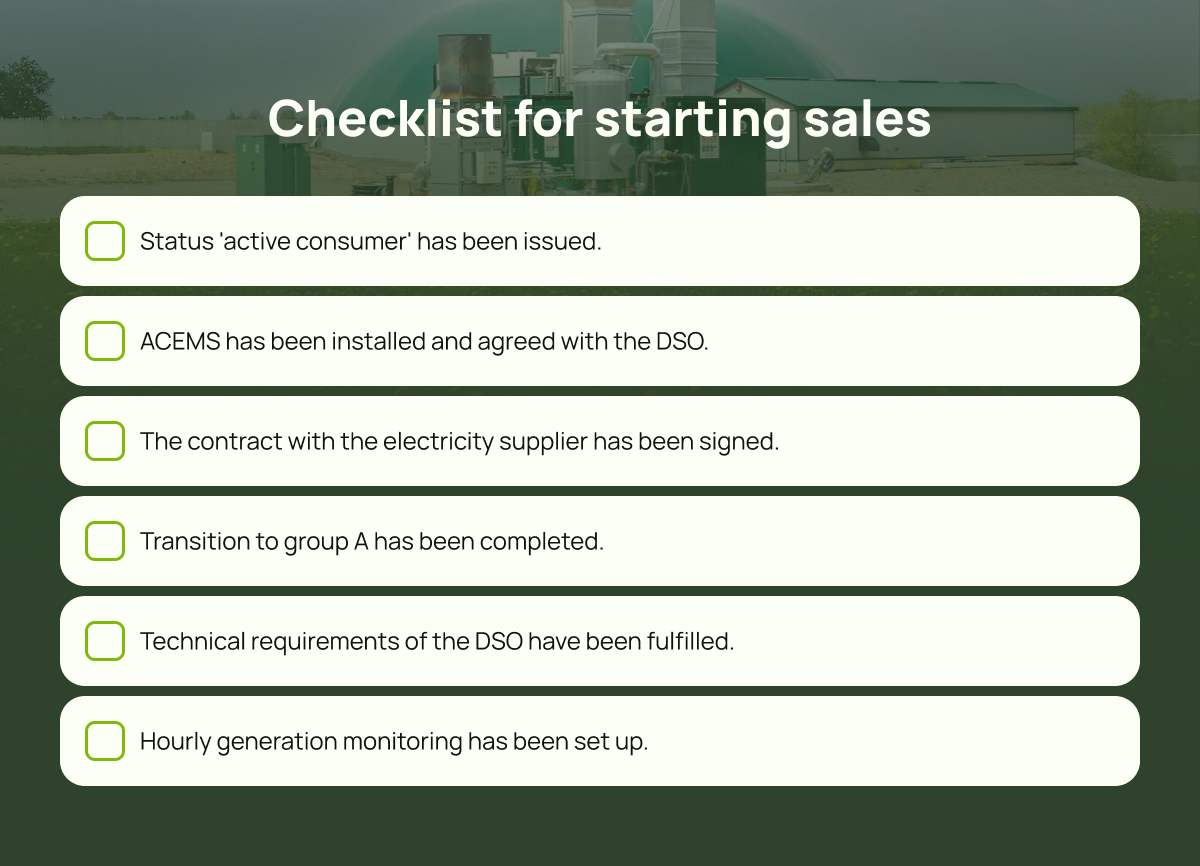
To start selling, you will need:
It is important to understand that the sale of surplus electricity generates additional revenue for the company, on top of the primary economic benefits of cogeneration. As long as the CHP plant meets the facility’s own electricity and heat requirements, the company saves on purchasing electricity from the grid and on transmission and distribution charges, whilst also protecting itself from market price fluctuations. If, however, some of the electricity generated remains unused, it can be sold back to the grid to generate additional revenue.
Let us consider a company with a cogeneration plant with a capacity of 500 kW and a contracted connection capacity of 600 kW. In accordance with the requirements for an active consumer, the maximum volume of sales is 300 kW.
The calculation set out below is a hypothetical scenario intended to illustrate the principle of revenue generation. Actual revenue depends on the enterprise’s hourly consumption profile, prices on the “day-ahead” market (DAM), technical constraints, the terms of the contract with the electricity supplier, and the operating mode of the cogeneration plant.
If a plant operates for 4 hours every day during the evening peak, and the average day-ahead price during this period is 12 UAH/kWh, the economics might look like this.
Monthly sales will amount to:
300 kW × 4 hours × 30 days = 36,000 kWh
In this hypothetical example, let us assume that the calculated buy-back price is 90 per cent of the average day-ahead market price, in accordance with the terms of the contract. In that case, the actual revenue will amount to:
36,000 × 12 UAH × 0.9 = 388,800 UAH per month
At the current exchange rate, this amounts to almost €8,600 in additional income each month, which the company receives on top of the savings from its own electricity consumption.
Revenue from cogeneration depends not only on the plant’s capacity, but also on the volume of surplus electricity, day-ahead market prices, the cogeneration unit’s operating mode and the terms of the contract with the electricity supplier.
Similar solutions have already been implemented in Ukraine — the Pro-Energy portfolio includes cogeneration projects in which businesses combine their own electricity consumption with the sale of surplus electricity to the grid, thereby generating additional income from the operation of the plant.
The final profit depends on several factors. First and foremost, these are the capacity of the power generation unit and the volume of surplus generation that can be sold. Day-ahead market prices have a significant impact, as they vary depending on the season, consumption levels, and the situation in the power system. The plant’s operating hours are also important: sales during the evening peak usually generate significantly higher revenue than at night. The commercial terms of the contract with the electricity supplier play a key role, as these determine the actual purchase price for surplus electricity.
We discussed the benefits of cogeneration for SMEs in more detail in a separate article: “Cogeneration for Small and Medium-sized Enterprises“.
The choice of electricity supplier affects not only the convenience of the service but also the actual income generated from selling surplus electricity. Different companies offer different terms for purchasing electricity, so it is worth carefully comparing the available offers before signing a contract.
First and foremost, it is worth paying attention to the terms governing the calculation of the electricity purchase price, the payment schedules, any requirements regarding minimum sales volumes, as well as additional services such as price forecasting or advisory support. Particular attention should be paid to the supplier’s reputation and financial reliability.
Independent suppliers
Independent traders and suppliers often offer more competitive commercial terms, a more flexible approach to collaboration and faster contract finalisation. The terms for the purchase of electricity may be more favourable, depending on the pricing model and payment arrangements.
Suppliers associated with regional electricity distribution companies
Such companies usually have well-established processes for liaising with distribution system operators, which can simplify organisational procedures. At the same time, the terms for purchasing surplus electricity may be less flexible, so it is worth comparing them carefully before signing a contract.
Before signing the contract, it is worth clarifying the following:
Selling surplus electricity can generate significantly higher revenue if the operation of the combined heat and power plant is organised correctly. The key objective is to generate and sell electricity precisely when its market price is at its highest.
The most cost-effective approach is to make maximum use of the combined heat and power (CHP) plant during the evening peak hours, when day-ahead market prices reach their highest levels. At the same time, during the night, when the cost of electricity falls significantly, it is advisable to reduce generation or to use it solely for in-house consumption. To maximise revenue, it is important to monitor market prices regularly and adjust the plant’s operating mode in line with the current situation.
Modern energy management systems (EMS) make it possible to automate this process. They analyse a company’s energy consumption, monitor market prices and automatically adjust the operating modes of power generation units based on economic viability. This helps to improve the profitability of power generation and reduce the workload on staff.
An even greater benefit can be achieved by combining a cogeneration plant with an energy storage system (ESS). In this case, batteries can be charged during off-peak hours or using surplus generation, and the stored electricity is used or sold back to the grid during peak tariff periods. This approach allows the electricity generated to be used as efficiently as possible and increases the revenue from its sale.
At the same time, when implementing such projects, it is important to take into account the technical and regulatory aspects of cogeneration plant operations. For more details on the main challenges facing the sector, see the article “Challenges to the Development of Cogeneration in Ukraine“.
The most common problems:
Any one of these mistakes could reduce profits or even lead to sales being halted.
A combined heat and power plant is capable not only of supplying the business with its own electricity and heat, but also of creating a new source of income.
Active consumer status allows up to 50 per cent of the connection capacity to be sold without the need for a generation licence, whilst the self-generation mechanism opens up the possibility of monetising surplus electricity. In scenarios with sufficient surplus generation and sales during peak-price hours on the day-ahead market, the potential additional income for a 300–500 kW household power plant could reach €7,000–10,000 per month.
If you are planning to install a cogeneration system or wish to assess the possibility of selling surplus electricity, the Pro-Energy team will help you develop the best technical and economic solution for your business.
Up to 50 per cent of the facility’s contracted capacity. For a CHP plant with a capacity of 500 kW and a contracted capacity of 600 kW, this amounts to up to 300 kW for sale. The plant’s capacity must not exceed 5 MW.
Through the self-generation mechanism. The enterprise enters into a contract with an electricity supplier; surplus electricity is fed into the grid and purchased in accordance with the terms of the contract. The price may be determined taking into account day-ahead market prices, the commercial component, balancing costs and other agreed terms.
No. Active consumer status allows you to sell surplus electricity without a producer’s licence, provided that the established restrictions are observed.
A bidirectional meter, an ASK-O, a data transmission modem, relay protection and equipment for synchronisation with the grid are required.
For a 500 kW power plant, selling 300 kW during the evening peak could generate approximately €7,000–10,000 per month, depending on the day-ahead market prices and the terms of the contract with the supplier.
Send us a request, and we’ll personally provide the answers during a consultation.
Thank you for your request! The manager will contact you shortly to answer all your questions.
In the meantime, check out our implemented projects.
Periodically, you will receive letters from us with all the latest news from the field of bioenergy.
So that the letters do not end up in spam, please add info@pro-energy.com.ua to the list of contacts in the mail.
We will be in touch!