What CHP capacity does your business require? A practical calculation method

Oleh Yovzhenko — 04.08.2026


Oleh Yovzhenko — 04.08.2026
The most common question asked by business owners before implementing cogeneration is: “Which cogeneration unit should I install?”. In fact, this question boils down to two others: how to choose a cogeneration system specifically for your business, and how many kW of cogeneration capacity are required for the system to operate economically and pay for itself within the planned timeframe.
But the answer is not straightforward. A plant that is too small will not deliver the expected economic benefits, whilst one that is too large simply won’t pay for itself if it operates at less than full capacity.
In this article, we have outlined a five-step process to help determine the optimal capacity of a cogeneration plant. This information will be useful to business owners, chief power engineers, and financial directors who are considering cogeneration as a means of achieving energy independence.
Selecting the capacity of a cogeneration plant is one of the key factors that directly determines the economic viability of the entire project. An error in either direction costs money.
If the capacity is underestimated, the system will not be able to meet the plant’s base load. Some electricity will still have to be purchased from the grid, and the savings will be significantly lower than they could have been. Furthermore, the heat generated by such a CHP unit is often insufficient even for basic needs — such as hot water supply or industrial processes.
The opposite situation is no better. An excessively powerful unit, with a margin ‘just in case’, operates at 30–50 per cent of its rated power most of the time, which means low efficiency under partial load. There is simply nowhere to put the excess heat — it is lost. As a result, the payback period is longer, and maintenance costs are higher, as the cost of servicing a large engine does not depend on how fully loaded it is.
Making the most of the heat generated significantly improves the economic efficiency of a cogeneration plant. It is technically possible to discharge some of the heat, but this must be taken into account when calculating the project’s economic model.
Ideally, a CHP plant should operate most of the time at 70–90 per cent of its rated capacity, with the heat generated being utilised as fully as possible to meet the plant’s needs. It is precisely this approach that enables the best possible economic efficiency to be achieved and forms the basis for the sound design of a cogeneration system.
The calculation of the capacity of the CHP consists of five consecutive steps — from analysing consumption to assessing the project’s cost-effectiveness.
To begin with, you need to gather the relevant data: electricity bills for the last 12 months, an hourly consumption schedule (if available) and the maximum power rating specified in your contract with the regional electricity distribution company.
Based on this data, we calculate:
It is worth taking a separate look at the breakdown by time: day/night, weekdays/weekends.
Example: consumption of 150,000 kWh/month, operating 16 hours/day × 25 days = 400 hours. Average load: 150,000 / 400 = 375 kW. Base load (night-time minimum) — 250 kW, peak load — 500 kW.
Next, we collect gas bills for heating, hot water and process heat, monthly heat consumption data and a temperature chart for the heating season.
We calculate annual heat consumption in Gcal or kWh, the base heat load (domestic hot water, process heat, i.e. what is required all year round), the seasonal heating load, and assess the potential for heat recovery in summer.
An important technical point. Most modern gas CHPs produce approximately 0.9–1.2 kW of thermal energy per 1 kW of electrical power, depending on the model and operating mode. A ratio of 1:1 is usually used for preliminary calculations.
Example: heating — 800 kW in winter, 0 kW in summer; domestic hot water — 100 kW all year round; process requirements — 200 kW all year round. Base heat demand — 300 kW, peak heat demand — 1,100 kW.
There are three questions to be answered here: how many hours a year will the plant actually operate, is off-grid operation required, and are there plans to sell surplus electricity?
| Mode | Hours per year | Comment |
| 24/7 base load | 8000 | Highest return on investment |
| Working hours | 4000–5000 | Typical for production |
| During the heating season only | 4000 | If you don’t need heating in the summer |
| Peak times | 3000–4000 | Sale of electricity during peak hours |
The rule is simple. A CHP plant pays for itself when it operates for more than 4,000 hours a year, and the optimal range is 6,000–8,000 hours a year. For more details on the specifics of operation in the Ukrainian context, read our article on cogeneration in Ukraine in 2026.
There are two approaches. The first is based on electricity: CHP = 70–90% of the base electricity load, with the remainder covered by the grid (peaks, reserve). The second is based on heat: CHP = the base heat load, and any surplus electricity is sold back to the grid.
Which approach to choose depends on the balance of requirements: if you need less heat than electricity, we base the calculation on heat to avoid any surplus; if you need more heat, we base the calculation on electricity, and the boiler makes up for any shortfall in heat.
Example: base electricity demand — 250 kW, base heat demand — 300 kW. As the heat demand exceeds the electricity demand, the calculation is based on the electrical load. The recommended CHP capacity is 200–250 kW; the heat generated by the plant covers 65–85 per cent of the base demand.
The final step is to calculate the payback period. You need to take into account the capital expenditure (CAPEX), savings on electricity and heating, and annual gas and maintenance costs.
Net savings = (electricity + heat) – (gas + maintenance). Payback period = CAPEX / net savings. A payback period of 3–5 years is considered normal. Current guidelines on equipment costs can be found in the article ‘How much does a cogeneration plant cost in Ukraine’.
If the estimated payback period exceeds 6 years, it is worth reducing the capacity of the CHP unit, increasing its operating hours, or checking whether the heat is being fully utilised.
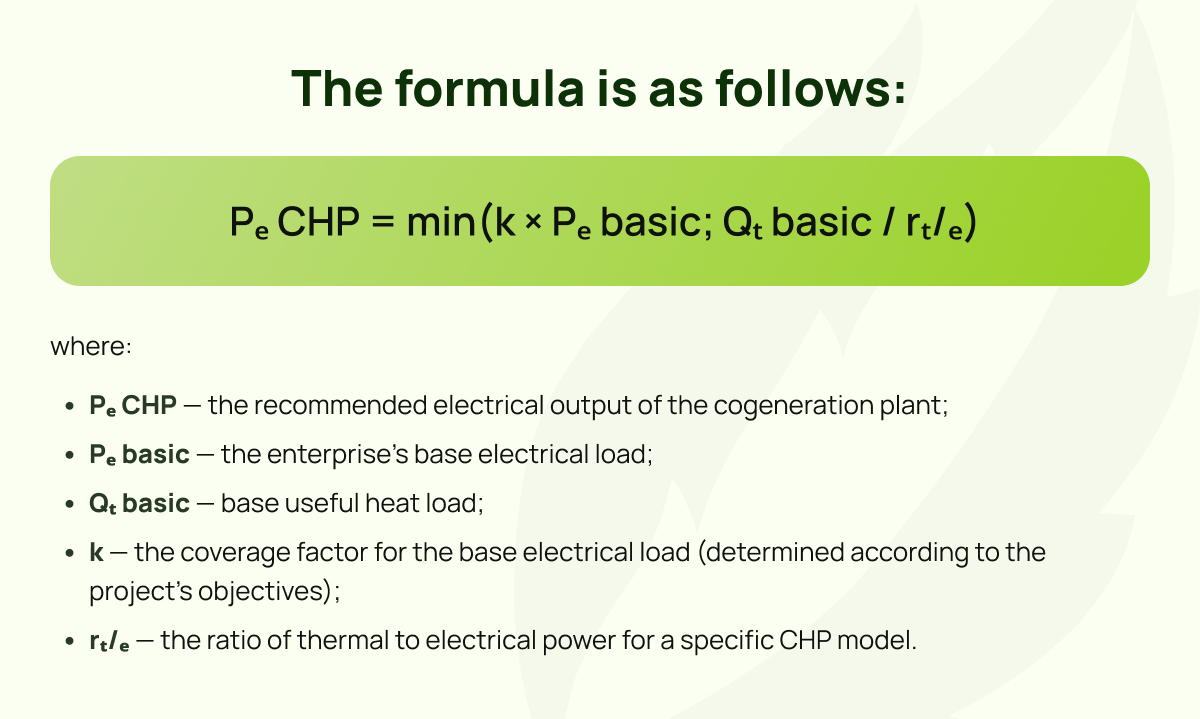
At the preliminary assessment stage, the recommended electrical output of a cogeneration plant is determined as the lower of the following two values:
Example
The plant’s base electrical load is 300 kW, and its base thermal load is 240 kW. For the selected CHP unit model, the ratio rₜ/ₑ = 1.0, and the coverage factor k = 0.8.
Calculation:
Therefore, the recommended electrical power for the CHP is 240 kW.
Important: this formula is used for preliminary assessment only. The final selection of a cogeneration plant is based on hourly electricity and heat consumption profiles, the plant’s operating modes, seasonal load fluctuations and the technical specifications of the selected equipment model.
The table below will help you quickly estimate how many kW of cogeneration capacity are required by different types of businesses. The final decision on the capacity of a cogeneration plant is always made following an analysis of the electrical and thermal loads.
| Type of business | Power of the CHP | Note |
| A hotel with 50–100 rooms | 100–200 kW | With a swimming pool / spa — more |
| A hotel with 100–200 rooms | 200–400 kW | Trigeneration in summer |
| Shopping centre: 10,000 m² | 300–500 kW | Trigeneration is mandatory |
| Shopping centre: 25,000 m² | 600–1,000 kW | A cascaded configuration is possible |
| Dairy plant | 200–500 kW | High heat consumption |
| Poultry farm | 300–800 kW | Biogas-powered CHP plant |
| Pig farm | 200–500 kW | Biogas-powered CHP plant |
| Greenhouse complex | 500–2,000 kW | Maximum heat recovery |
| Woodworking | 200–500 kW | Possibly using biomass |
There are specific solutions available for small and medium-sized businesses that enable them to implement cogeneration without excessive investment — for more details, see the article “Cogeneration for Small and Medium-Sized Businesses“.
Electricity consumption — 120,000 kWh/month, operating 24/7. Average load — 165 kW, base load — 140 kW. Heat consumption (hot water and pasteurisation) — 180 kW continuously.
Electricity: 140 × 0.8 = 112 kW. Heat: 180 kW. Electricity is always the limiting factor. The recommended capacity is 100–120 kW; the heat generated by the system covers 55–65 per cent of the demand, with the remainder provided by the boiler.
80 rooms, electricity consumption — 80,000 kWh/month. Average load: 110 kW; base load: 70 kW. Heating: 50 kW for domestic hot water + 80 kW for the swimming pool + 150 kW for heating in winter. Base heating load: 130 kW.
Electricity: 70 × 0.8 = 56 kW. Heat: 130 kW. The limiting factor is electricity. The recommended capacity is 50–70 kW, or more (up to 100 kW) if the surplus is to be sold.
Floor area — 20,000 m², electricity consumption — 198,000 kWh/month. The shopping centre operates 12 hours a day. The average electrical load during operating hours is 550 kW, whilst the base (night-time) load is 350 kW. Thermal load: heating — 400 kW in winter, hot water supply — 30 kW; cooling demand for air conditioning in summer — approximately 500 kW of cooling capacity.
Calculation:
Solution: the use of trigeneration, whereby heat from a cogeneration plant is used to produce cooling via an absorption chiller. Recommended cogeneration plant capacity: approximately 300 kW in combination with an absorption chiller.
A similar approach was examined in detail in the case study on a combined heat and power plant for a shopping centre and in the article on reliable energy supply for shopping centres.
Where off-grid operation is critical to a business, the power supply system must be capable of handling the critical load with an additional margin of 20–30 per cent to account for inrush currents. A prioritisation system for non-critical loads should also be put in place.
Critical load — 200 kW. Taking into account inrush currents: 200 × 1.3 = 260 kW. The minimum power output of the generator set for island operation is 260–300 kW.
A simpler system, lower capital expenditure, but with no backup — in the event of a breakdown, the company is left without its own power generation.
Several smaller units provide redundancy. If one fails, the others continue to operate. A cascade system handles variable loads more effectively, although the capital costs are higher and control is more complex.
A cascaded configuration is worth considering when equipment redundancy, flexible operation under variable loads, or the phased expansion of generating capacity are important. This approach is particularly relevant for large enterprises and facilities where even a brief interruption to in-house generation can lead to significant financial losses. A cascade configuration should also be chosen if a single unit cannot cover at least 50 per cent of electricity consumption based on its rated capacity.
Over the years of implementing projects, the Pro-Energy team has analysed dozens of scenarios for selecting cogeneration plants. Most problems arise even before construction begins — at the capacity determination stage. The most common mistakes are listed below.
For more on other practical challenges involved in implementation, see the article on the challenges of cogeneration in Ukraine.
The optimum capacity of a combined heat and power (CHP) unit is 70–90 per cent of the base load, determined by the limiting factor: electricity or heat, depending on which resource the enterprise requires less of. Calculating the CHP capacity involves five steps: electricity analysis, heat analysis, determining the operating mode, selecting the capacity, and checking the economic viability.
The typical payback period is 3–5 years, assuming more than 4,000 hours of operation per year. For off-grid operation, allow for a 20–30 per cent margin, and for high-capacity systems, consider a cascade configuration.
To obtain an accurate CHP capacity calculator tailored to your business, please contact the engineers at Pro-Energy — they will carry out a comprehensive analysis of your energy profile and select the optimal solution.
Simplified formula: CHP capacity = the lower of (base electrical load × 0.8) and (base thermal load). The CHP should operate at 70–90 per cent of its capacity for most of the time, and all heat should be utilised.
For a hotel with 50–100 rooms — 100–200 kW. For a hotel with 100–200 rooms featuring a spa and swimming pool — 200–400 kW. The exact calculation depends on electricity consumption, hot water requirements, and whether there is a swimming pool.
A single CHP is simpler and cheaper. A cascade configuration (2–3 UPS units) provides redundancy and better performance under variable load conditions. A cascade configuration is recommended for power ratings above 500 kW or where uninterrupted power supply is critical.
The minimum for payback is 4,000 hours per year. The optimum is 6,000–8,000 hours per year. Under 24/7 operating conditions, it is possible to achieve 8,000 hours; if operating only during working hours, the figure is 4,000–5,000 hours.
Options: trigeneration (an absorption chiller converts heat into cooling), operation of the CHP plant only during the heating season, lower CHP plant capacity — based on the base heat load (DHW + process heat).
Send us a request, and we’ll personally provide the answers during a consultation.
Thank you for your request! The manager will contact you shortly to answer all your questions.
In the meantime, check out our implemented projects.
Periodically, you will receive letters from us with all the latest news from the field of bioenergy.
So that the letters do not end up in spam, please add info@pro-energy.com.ua to the list of contacts in the mail.
We will be in touch!