How to connect a cogeneration system to the electricity grid

Ruslan Delidon — 15.05.2026


Ruslan Delidon — 15.05.2026
Connecting to cogeneration for business is a way to take control of your energy consumption and costs. The most common model in Ukraine is the “active consumer” status, which allows you to combine parallel operation with the grid and off-grid operation of the CHP plant/self-sufficiency during power cuts.
In this article, Pro-Energy’s experts will examine how connecting a cogeneration system to the grid works, the three options for installing a power generation unit in accordance with current regulations, and provide a step-by-step guide on what needs to be done, from the initial analysis to generating income from the sale of surplus electricity.
The current Distribution System Code (NEURC resolution) sets out three fundamentally different schemes for owners of generating facilities. The choice must be made at the design stage, as the technical configuration of the generating facility and the necessary documentation depend on this.
The requirements are set out in Chapter 4.12.2 of the Distribution System Code.
This is the simplest setup. Cogeneration plants operate exclusively to meet the enterprise’s own needs. The electricity generated is not fed into the distribution system operator’s (DSO) grid, and the capacity of the CHP plant is not limited by the contracted capacity rule, but is determined by the technical specifications of the facility already connected to the grid and the DSO’s requirements.
The procedure is of a declaratory nature. The owner submits a notification to the distribution system operator (DSO), whereupon the DSO carries out an inspection and amends the distribution point certificate. The procedure is simplified, but requires the technical solutions to be agreed upon with the DSO.
This option is suitable for businesses with a consistent daily load that do not plan to sell surplus electricity.
This option is also governed by Section 4.12.2 of the Distribution System Code.
The “active consumer” status is the most suitable option for most businesses installing cogeneration systems. The cogeneration unit is connected within the scope of the balance sheet within the company’s own networks and can operate in parallel with the DSO’s network, whilst selling any surplus electricity.
Restrictions to bear in mind in advance:
Surplus electricity can be sold via three mechanisms: at market prices on the wholesale market, through an electricity supplier under the self-generation mechanism, or via the bilateral contract market. The specific mechanism depends on the requirements of the transmission system operator, the terms of the contract and the chosen electricity metering model.
If a company plans to sell electricity on the wholesale market, it must become a participant in that market and comply with all the requirements of current legislation governing transactions on the electricity market.
This approach is ideal for businesses that want to sell surplus energy, require an island mode during power cuts, and aim for complete independence from external factors.
In accordance with Chapter 9 of Section X of the Technical Operating Rules for Consumer Electrical Installations.
The UPS only switches on when the mains power supply fails. The power generated is used solely to meet the system’s own needs; no power is fed back into the grid. In effect, this is a configuration similar to a “non-exporting consumer”, but with an emphasis on backup power.
Connection is based on a declarative principle. The owner implements security measures, draws up instructions on the procedure for activation, and coordinates these with the DSO in the “Operational Management” section. No further approval is required for the connection.
Suitable for critical infrastructure facilities where an uninterrupted power supply has a direct impact on safety and financial performance. These include hospitals, data centres, industrial plants and other facilities for which even a brief outage can result in significant losses or operational risks.
To choose the right plan, compare the key features of the three options:
| Parameter | Consumer | An active consumer | Battery power |
| Sale of surplus stock | No | Yes (up to 50%, depending on the terms of the DSO and the contract) | No |
| Power of the CHP | No restrictions | ≤ contractual, ≤ 5 MW | No restrictions |
| Operating in parallel with the mains supply | Yes | Yes | No |
| Island mode | Yes | Yes | Yes |
| Licensing | No | No | No |
| The complexity of the procedure | Low | Average | Low |
For most businesses with an investment horizon of 3–5 years, “active consumer” status is the most advantageous, as it combines parallel operation, island mode and the ability to monetise surplus capacity.
This model involves the use of a diesel generator set to provide autonomous or backup power to the company’s own power consumers.
In this case, the electricity is used exclusively for its own consumption and is not fed into the distribution network.
1. Analysis of the facility’s hourly consumption
An analysis is being carried out:
This enables you to select the correct capacity of the gas generator to meet your own needs.
2. Analysis of existing electrical networks
Checking:
3. Selection of a site for the CHP
The following are determined:
At this stage, it is important to rely on practical experience rather than theory, as mistakes made at this stage directly affect the project’s payback period. Pro-Energy’s completed cogeneration projects are proven solutions that are already in operation across various sectors. They demonstrate how to correctly implement the connection of cogeneration to the grid, avoid restrictions, and achieve stable sales of surplus electricity.
4. Development of the CHP design and connection diagram
The project includes:
5. Development of operating procedures and workflows
In progress:
6. Network modernisation project (if required)
Provides for:
7. Installation of equipment
In progress:
8. Coordination of operating procedures with the DSO
In accordance with the requirements:
The operation of the CHP is permitted without further approval from the DSO, but without the possibility of feeding electricity into the grid.
9. Commissioning of the CHP
The following are being held:
10. Operating in self-consumption mode
CHP provides:
As a result, the consumer receives:
Some stages can be carried out in parallel once the technical specifications have been received or preliminary approval for connection has been granted. For example, design work and preparations for equipment procurement can take place simultaneously, thereby reducing the overall project duration without the risk of rejection by the distribution system operator.
This model provides for the parallel operation of the CHP with the DSO network and the possibility of feeding surplus electricity into the grid.
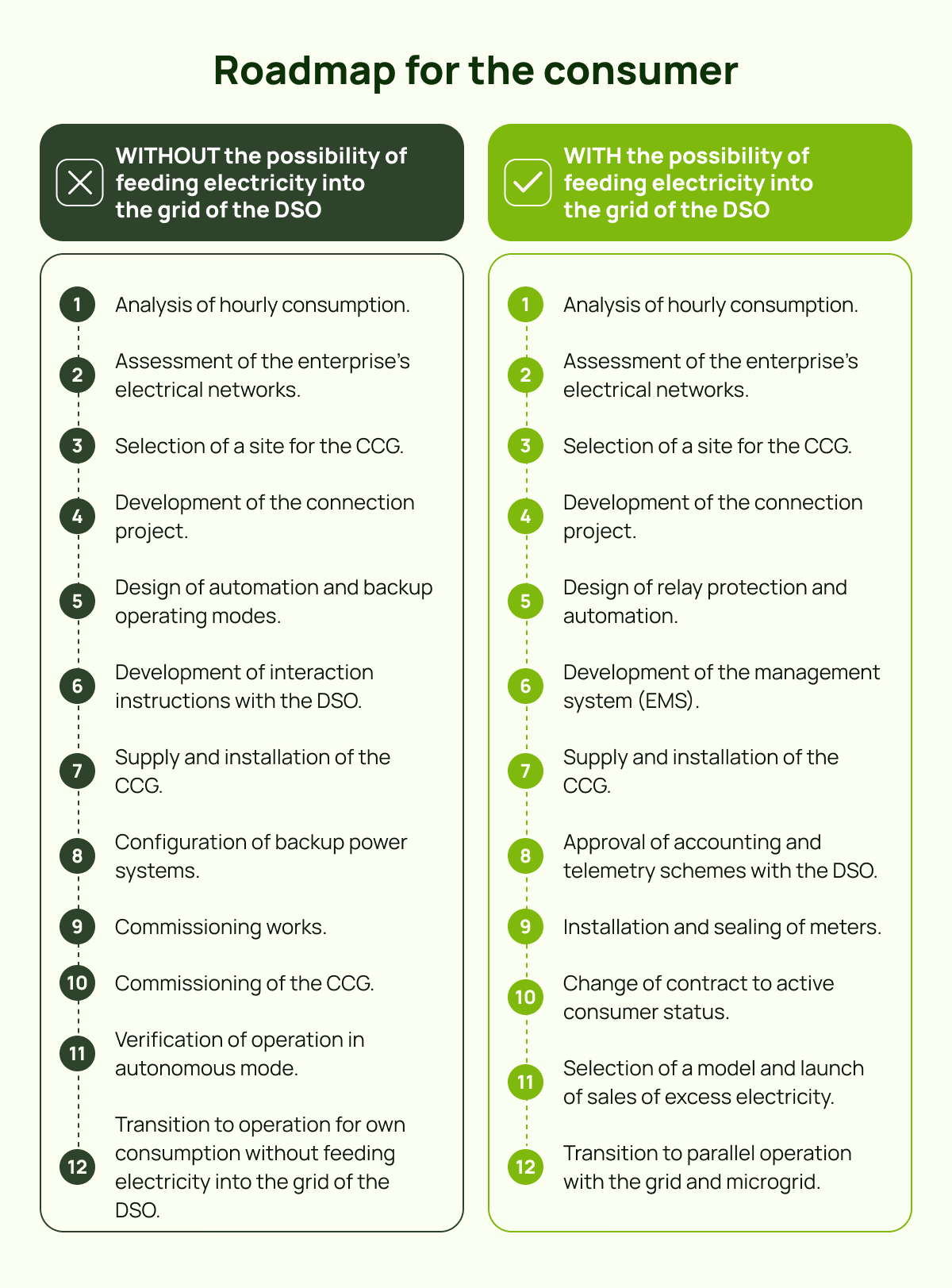
1. Analysis of hourly consumption
The following are analysed:
2. Analysis of OSD networks
The following is being checked:
3. Selection of the site and parameters for the CHP
The following are taken into account:
It is important to bear in mind the technical limitations of the DSO:
4. Development of the CHP design and connection diagram
The project includes:
5. Development of process control systems and EMS
The system provides:
6. Network modernisation project
Provides for:
7. Installation of equipment
In progress:
8. Approval of design solutions by the DSO
The following are agreed:
9. Inspection and sealing of metering units
Representatives of the DSO:
10. Making changes to the distribution point details
The DSO is making changes regarding:
11. Obtaining “Active User” status
In progress:
12. Sale of surplus electricity
Possible mechanisms:
As a result, the active consumer receives:
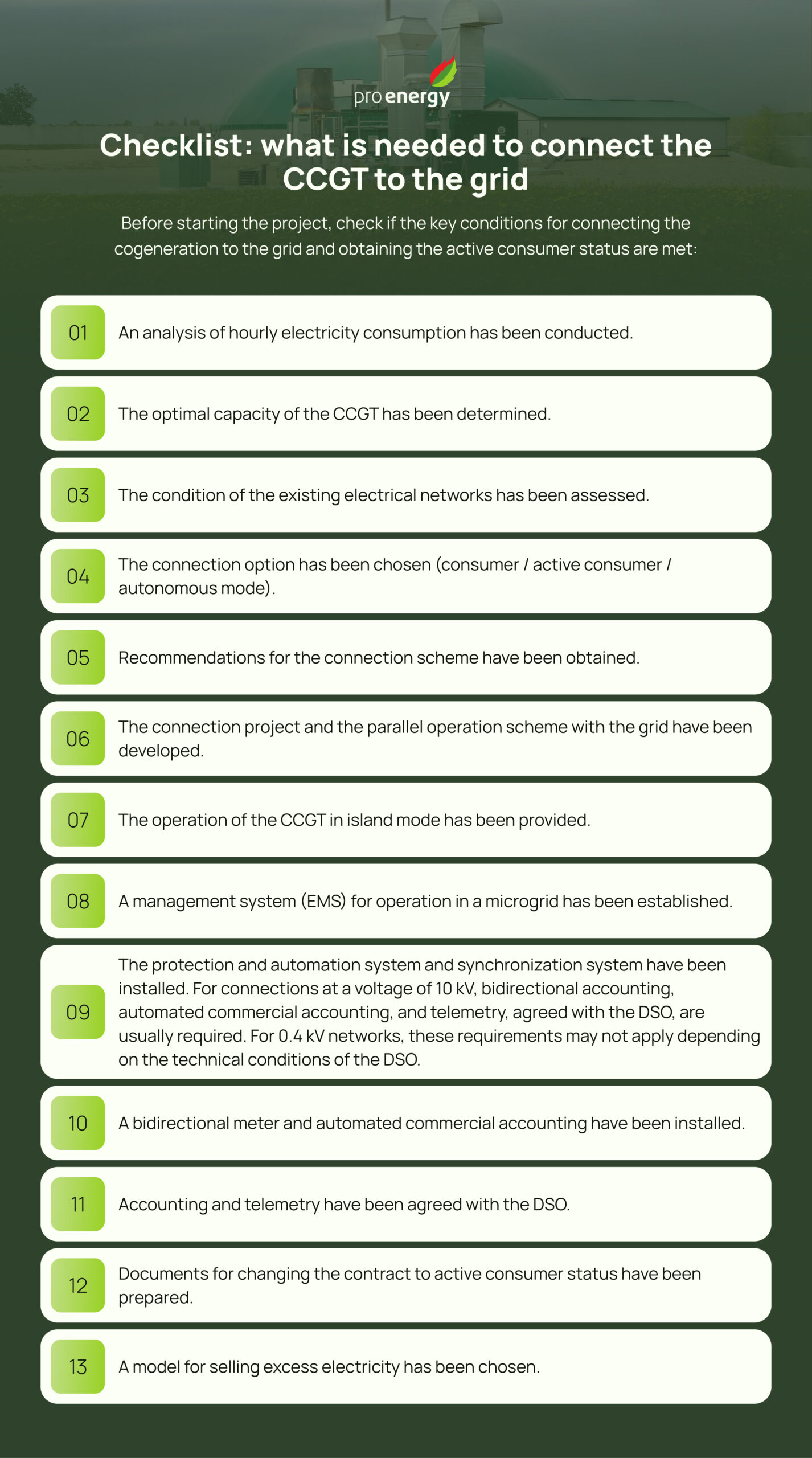
For the CHP to operate in parallel with the DSO network, a specific set of equipment is required, and technical specifications must be met. Without these, the DSO will not approve the connection.
Each of these components must comply with the technical specifications of the relevant distribution system operator — these requirements may vary depending on the region and the voltage class of the connection point.
The standards specify several mandatory functions:
A detailed list of requirements can be found in the Distribution System Code (Chapter 4.12). Before starting the design work, you should obtain the technical specifications from your DSO — these set out the specific requirements for your connection point.
Off-grid operation refers to a business switching to a self-sufficient electricity supply without connection to the external grid. It is precisely this feature that has become the key factor for businesses when opting for cogeneration during wartime, when power cuts last between 4 and 18 hours a day.
Read more about the benefits of cogeneration in wartime on our blog.
A microgrid is a local smart energy supply system that integrates generation (cogeneration units), consumption and, where available, energy storage. If the external grid fails, the system automatically switches to off-grid mode.
Benefits for businesses:
The challenges involved in implementing a microgrid lie in the fact that a fully-fledged microgrid requires an energy management system (EMS) capable of balancing generation and load in real time. It also requires the modernisation of the distribution board and staff training in operating under non-standard conditions.
In most projects, island mode is configured automatically. If the mains supply is lost, the CHP automatically disconnects from the mains and switches to supplying its own loads.
“Active consumer” status is not merely a legal formality. It offers four specific economic benefits.
1. Reduced electricity costs.
On-site generation enables a business to partially or fully replace the electricity it draws from the grid.
At current natural gas prices, the cost price of electricity from the CHP is estimated at 7–8 UAH/kWh. However, the actual cost of electricity for industrial enterprises, taking into account:
Ranges from 12 to 15 UAH/kWh depending on the voltage class and consumption pattern.
One of the key economic benefits of active consumer status is that a business reduces the amount of electricity it purchases from the grid, thereby cutting its transmission and distribution costs.
The greatest economic benefit is achieved when:
2. Additional income from the sale of surplus stock.
For a 500 kW solar power plant with a contracted capacity of 500 kW, the amount of electricity fed into the grid can be up to 250 kW. This represents actual revenue, which shortens the project’s payback period.
At the same time, the economics of sales are directly dependent on the situation in the electricity market. During the spring and summer months, there is often a surplus of generation in the market, so prices may fall even for electricity supplied from the grid. In the autumn and winter months, the situation changes — due to a shortage of generation and rising consumption, market prices usually increase.
This is precisely why active consumer status gives businesses greater flexibility: a company can use its own generation to cover internal consumption during peak hours and sell any surplus when market prices are favourable.
3. Standalone operation during power cuts.
Island mode ensures uninterrupted production operations regardless of power cut schedules. For food manufacturers, hotels and logistics centres, this represents a competitive advantage that directly impacts operational continuity and service quality.
4. Stability of business processes.
Off-grid storage eliminates dependence on the distribution system operator’s decisions regarding power cut schedules. The business itself controls when and how much to draw from the grid, and when to switch entirely to its own generation.
Connecting a cogeneration plant to the grid requires a sound project approach: from consumption analysis to selling surplus electricity. Errors at any stage limit capacity or make it difficult to obtain active consumer status.
IKNET provides a full range of services for cogeneration for businesses:
Experience:
Pro-Energy, in partnership with the engineering firm IKNET, delivers turnkey projects for connecting gas-fired power plants — from energy audits to entry into the electricity market.
The Distribution System Code sets out three clear options for owners of small-scale power generation facilities. “Consumer without supply” and “self-supply” are simple schemes with minimal requirements, but without the possibility of monetising surplus energy. The “active consumer” status is optimal for businesses: 12 steps from analysis to generating income, parallel operation with the grid and island mode during blackouts.
The key is to choose the right plan from the outset. The technical configuration, project documentation, and list of approvals all depend on the plan you choose. Changing the plan during implementation costs time and money.
Pro-Energy delivers turnkey cogeneration projects — from feasibility studies and the selection of cogeneration equipment to obtaining “active consumer” status and commissioning.
Please contact us for advice, and we will select the best connection plan and calculate the actual payback period for your business.
An active consumer is a consumer who generates electricity and sells any surplus. For CHP: the capacity does not exceed the facility’s contracted capacity and 5 MW of installed generating capacity, with a maximum of 50% fed into the grid. No generation licence is required.
Under the “active consumer” status, you can sell up to 50% of your contracted capacity. There are three options: selling to the electricity supplier under the self-generation scheme, selling on the wholesale market at market prices, or via the bilateral contract market.
Island mode — autonomous operation of the CHP plant when the external grid is disconnected. The facility becomes a microgrid: it balances generation and consumption independently. This requires an EMS system (if other equipment, such as a distribution board, is present) and the appropriate automation, which is usually already integrated into the plant and supplied by the CHP plant manufacturer.
To obtain active consumer status, you usually need to complete 12 main steps:
No, a generation licence is not required to qualify as an “active consumer”. Restriction: the capacity of the small-scale power plant must not exceed 5 MW of the total capacity of all generating units. For higher capacity or for selling electricity in certain market segments, a “producer” status and the relevant licence are required.
Send us a request, and we’ll personally provide the answers during a consultation.
Thank you for your request! The manager will contact you shortly to answer all your questions.
In the meantime, check out our implemented projects.
Periodically, you will receive letters from us with all the latest news from the field of bioenergy.
So that the letters do not end up in spam, please add info@pro-energy.com.ua to the list of contacts in the mail.
We will be in touch!